WHEN hurricanes hit, or World Wars, when inflation goes crazy and times get tough, sometimes the things we take for granted disappear over night. You can be without electricity, without natural gas, without propane or without a home even. When we are suddenly forced to GO NATURAL... in the KITCHEN... when there is no gas coming in through pipes from the city utility company, no ELECTRICITY ...When your costly porcelain RANGE is deader than the proverbial doornail, who you gonna call? That's easy! A BRICKLAYER! You are going to build a big ole chimney, one so high in the arch that you can lean into it to fetch those cast iron pans that tolerate being set in coals without knocking your head on the proscenium.
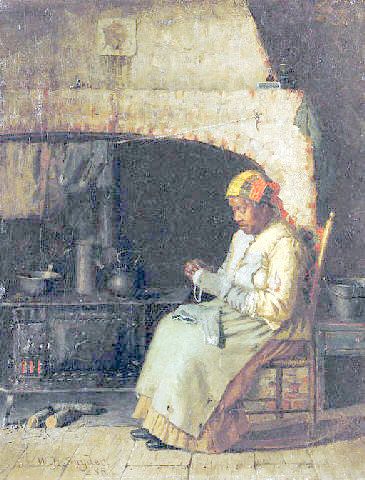
In the really early days, they didn't have an iron stove to stick in
that space, to contain the logs or coal. When people started building fireplaces,
the HEARTH was much simpler. An arch so the cook wouldn't bump her
head, a floor to cook on. A rack to set on the coals. Probably earthenware
pots as cast iron pots didn't exist. At least they don't show up in Medieval
museums. That fireplace was used it for cooking. You might add a fire screen
so sputtering logs didn't burn holes in the cook's long skirts.
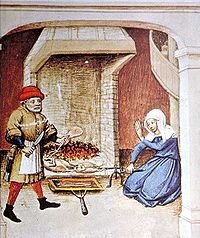
And you might raise the floor of the chimney so you don't have to kneel
on the floor but could sit on a stool.
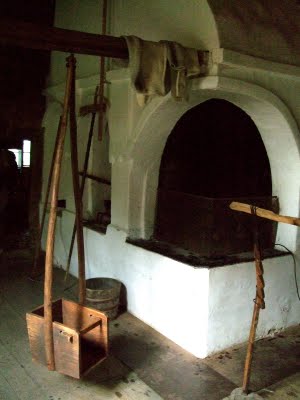
Now, you may think, I have a modern home, I don't want a rustic chimney in my kitchen. But just imagine for a moment that one day electricity goes to 400$ a month or 800$ and you really wish you had a cooking space that used home made coal, (made in a hole in the ground where you cover hardwood burning logs with soil, let it bake for a few days like a luau pig.) That gives you 'charcoal' which is very long burning when used in the chimney.
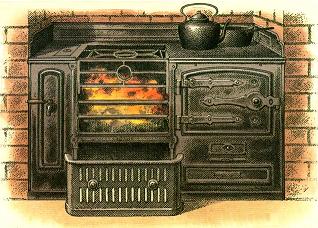
More recently, handy kitchen builders put a metal stove into the chimney
hole.
If you are not sure of having a house in the rustic look, take a look at an amazingly beautiful, spiritual Medeival owner built home in Wales. It has rustic flavor and it's one that would be easy to build. Cost this fellow three thousand pounds, isn't that like five thousand dollars US currency? Home is HUGE, well fitted out with built ins, window seats and very easy on the eyes. You have a feeling if local codes would allow this? http://www.simondale.net/house/ and http://www.simondale.net/house/build.htm
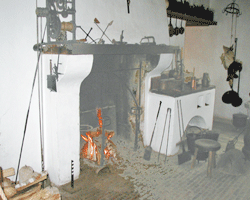
I imagine a kitchen in that Welsh house would look like this one above
here. It would have a shelf for pots, Probably built of bricks and plastered
over. A chopping board of end oak on top, jars for spices, bowls
of fruit or veggies. Note the small arched space below for keeping
hard wood logs.And the stool because the cook has to sit to move cassaroles
inside on the coals. Me, I'd add a rack.
What happened in the l8th century was that they added a cast iron stove to the COOKING SPACE. Don't you just love that? Ovens, now. What a step up!
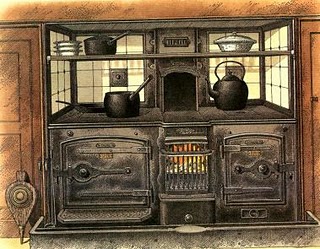
Perhaps you could find a used cast iron stove that wold fit in your chimney. That way you get an OVEN for baking cake, cookies & bread. I got the graphics for this iron stove and the one above -- at the website, http://secondriver.blogspot.com/2008_11_01_archive.html so go there to see pictures of COLONIAL HEARTHS. The text is fascinating as it takes us through the last few centuries of kitchen tech.
Some homes in the old days had a raised hearth so the cook didn't have
to bend over. Hauling heavy iron pots full of food can be hard on the back!
Famed "18th century Tavern cooking" Chef Walter Staib has a TV show called
the OPEN HEARTH and videos
http://historiccamdencounty.com/ccnews133.shtml
see him here:
He is a senior and looks like he wouldn't want to bend over much, though
on the Show he does. slapping heavy pots into the coals. I'd prefer the
raised hearth , myself.
Maybe you throw a rack into your chimney. Set your cast iron cooking ware on the rack. If you don't have a rack, you are forced to set things right in the coals. You might use "spider pots". They have legs so you can just place them in among the coals.
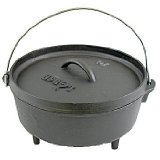
THE TOP of this one holds coals. It is called a Dutch Oven. Turn the
top over, set on coals and you can do pancakes. So as not to get ashes
blowing around on the hotcakes perhaps set it on the grill.
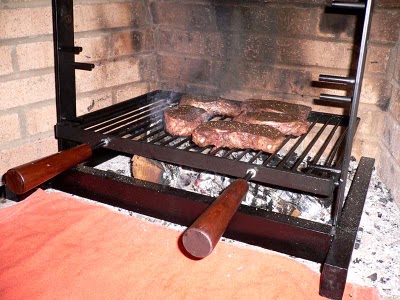
If you have a collection of cast iron pots or earthenware cassaroles, but none have legs...then, use an iron grill or rack. See below.
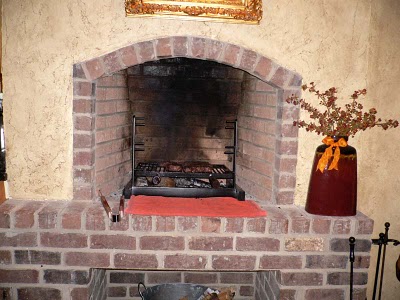
The rack sits above the coals Pots go on the rack. If you can't custom build a rack or grill on legs, you will have to find and use spider pots. Garage sales often have cast iron frying pans and pots but I've never seen a spider leg pot except online for sale. Brand new.
Here you'll see a close up of a bigger rack and bigger chimney: This
could be raised off the floor so the cook can sit in a chair.
In a way, our very best modern kitchen design reflects all these different inventions, the niche, the raised oven and burners, the ISLAND, the hanging cupboards as well as the work surfaces and below them, more cupboards.
Imagine today's million dollar kitchen suddenly without fuel, without natural gas piped in, without electricity.We know things can happen. Prices can change. Money flow can change. That's why I think when you build your country home, you want to hedge your bets. Be ready for anything. Be ready to go natural. or, if your farm HOUSE IS OLD and you're remodelling, read up on FIXING THE WIRING yourself.
PS. If no electricity, how does one wash clothing? There is a device -- a hand-powered agitator used in a sink, tub, or bucket to wash clothing quickly and (supposedly) easily. It could be an alternative for those who lack the space or the funds for a washing machine, or perhaps for those who want to simply wash those things that are supposed to be washed by hand or which may need washing when you have less than a full washer load, or for catastrophes when there is no electricity.
SEE FIREPLACES, DESIGNS YOU CAN MAKE YOURSELF
~^~^~^~^~^~^~^~^~^~^~^~^~^~^~^~^~^~^~
 Our
POSTER is ANITA SANDS HERNANDEZ, Los Angeles Writer, Futurist
and Astrologer. Catch up with her websites TRUTHS
GOV WILL HIDE & NEVER TELL YOU,
also The
FUTURE, WHAT'S COMIN' AT YA! & HOW TO SURVIVE
the COMING GREAT DEPRESSION, and
Secrets of Nature, HOLISTIC, AFFORDABLE HEALING. Also HOW
TO LIVE on A NICKLE, The
FRUGAL PAGE.*
Anita is at astrology@earthlink.net ). Get a 15$ natal horoscope "my money/future
life" reading now + copy horoscope as a Gif file graphic!
Our
POSTER is ANITA SANDS HERNANDEZ, Los Angeles Writer, Futurist
and Astrologer. Catch up with her websites TRUTHS
GOV WILL HIDE & NEVER TELL YOU,
also The
FUTURE, WHAT'S COMIN' AT YA! & HOW TO SURVIVE
the COMING GREAT DEPRESSION, and
Secrets of Nature, HOLISTIC, AFFORDABLE HEALING. Also HOW
TO LIVE on A NICKLE, The
FRUGAL PAGE.*
Anita is at astrology@earthlink.net ). Get a 15$ natal horoscope "my money/future
life" reading now + copy horoscope as a Gif file graphic!
<=== BACK TO TRACKING THE ECONOMY, an INDEX PAGE
<===BACK TO MONEY SECRETS ONLY THE EXPERTS KNOW
<=== BACK TO SECRETS THE GOV DOES NOT WANT YOU TO KNOW
<=== SHOW ME THE FIX INDEX PAGE.
<== SHOW ME THE HAPPY R)EVOLUTION PAGE
<=== BACK TO "GUERILLA CAPITALISM" -- THE SOLUTION!
<=== BACK TO REAL CAUSES OF THE MELTDOWN -- a WEBPAGE
<===BACK TO THE VULTURE SANDWICH, WORLD STARVATION INDEX PAGE
<=== BACK TO HOW TO STEAL A CORPORATION FROM THE STOCKHOLDERS
<=== GUERILLA CAPITALISM FOR YOU AND ME!
<=== BACK TO THE IMPORT EXPORT TRAINING SEMINAR
<=== BACK TO THE LEGACY TRADE SEMINAR
<===BACK TO THE ACTIVIST'S EASY BREEZY METHOD FOR EVOLUTION
<=== BACK TO THE EASY, BREEZY, NO WORK AT ALL GARDEN ARCHIVE for Suburban farmers
<== BACK TO ANITA SANDS ORIGINAL FORMULA WEBSITE
<==== BACK TO SUCCESSFUL CASH CROP FILE
<==== BACK TO THE FOOD INDEX PAGE
<=== BACK TO THE BUILDING THE COUNTRY HOME WEBPAGE